

Before you spend a dollar on search ads, you need to know the price of a click. The Google Ads cost per click (CPC) in your industry decides how far your budget goes and whether your ads can turn a profit. This guide explains what CPC is, shows typical CPC by industry ranges for 2026 and gives practical ways to pay less for every visitor.
What Is Cost Per Click in Google Ads?
Cost per click is the amount you pay each time someone clicks your ad. You do not pay for impressions on search ads, only for clicks. Google uses an auction, so your actual price depends on your bid, your ad quality and what competitors are willing to pay for the same keyword.
Average Google Ads CPC by Industry (Approximate Ranges)
Prices change by location, season and keyword, so treat these as rough guides rather than promises. Reports from across the advertising industry commonly show ranges like these for search campaigns:
- Legal services: often $6 to $10 or more per click, with injury and accident keywords reaching far higher in big cities
- Insurance and finance: commonly $4 to $8, with some terms much more expensive
- Home services such as plumbing and HVAC: roughly $3 to $7
- Dental and medical: around $3 to $6
- Real estate: often $1.50 to $3
- Restaurants and food: frequently under $2
- Ecommerce and retail: typically $0.50 to $2 on shopping and search campaigns
Your own account data is always the best benchmark. Google explains how pricing works in its Google Ads help centre.
What Makes CPC Higher or Lower?
- Competition: more advertisers bidding means higher prices.
- Quality Score: better ad relevance, expected click rate and landing page experience lower your costs.
- Location: big cities cost more than small towns.
- Keyword intent: “emergency plumber near me” costs more than “how does a faucet work” because buyers are ready to act.
- Device and time: bids can vary widely by hour and device.
Our Google & Meta Ads team manages these levers every day so clients stop wasting money on clicks that never convert.
CPC Is Not the Real Number: Cost Per Lead Is
A $10 click that turns into a customer is better than a $1 click that never does. The numbers that really matter are your cost per lead and cost per acquisition. Work backwards from what a customer is worth. If a new client brings in $1,000 and one in ten clicks becomes a lead who closes at 30 percent, you can afford a much higher CPC than you think. Strong lead generation work makes this math work.
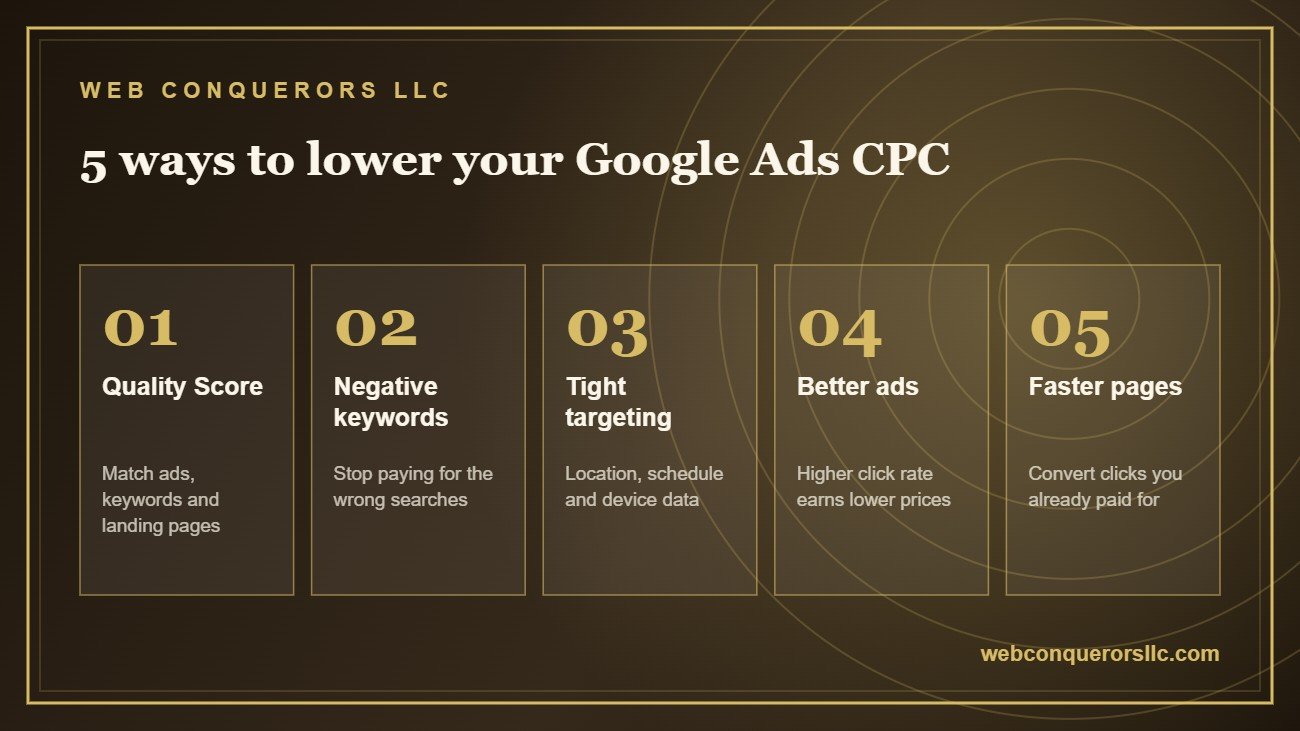
How to Lower Your Google Ads Cost Per Click
- Improve your Quality Score by matching ads, keywords and landing pages closely
- Add negative keywords so you stop paying for irrelevant searches
- Use exact and phrase match for your best terms instead of broad guesses
- Target tightly by location, schedule and device based on real data
- Write better ads that earn higher click-through rates
- Speed up your landing page and make the next step obvious
- Test continuously with fresh headlines, offers and bidding strategies
Google Ads or Meta Ads for Cheaper Clicks?
Meta clicks are usually cheaper, but they reach people who are not actively searching. Google clicks cost more but catch buyers at the moment of need. Most businesses do best with a mix. Read our detailed comparison of Google Ads vs Meta Ads to decide where your first dollars should go, and see our affordable online marketing services for smaller budgets.
Do Not Forget Organic Traffic
Every click you earn through search engine optimization is a click you never pay for. Many successful accounts combine paid ads for fast results with SEO for long-term savings. You can also review a real example in our case study on generating high-value injury leads through Meta Ads.
Conclusion
CPC varies enormously by industry, but the winning approach is the same everywhere: bid on intent, protect your Quality Score and measure cost per lead instead of cost per click. With careful setup, even expensive industries can run profitable campaigns.
Want to know what your clicks should really cost? Contact Web Conquerors LLC for a free review of your Google Ads account.