
When you run Meta ads to collect leads, you face an early choice: use Facebook Lead Ads, where people submit their details inside Facebook or Instagram, or send them to a landing page on your own website. Each can win, depending on your goal. This guide compares cost, lead quality and control so you can pick the right setup for your business.
How Facebook Lead Ads Work
With lead ads, a form opens inside the app, often pre-filled with the person’s name, email and phone number. They tap submit and you receive the lead. There is no page to load and no typing, which is why this format is popular. You can learn the basics in Meta’s own ads guide.
Advantages:
- Very low friction, so more people finish the form
- Usually a lower cost per lead
- Quick to set up with no website work
- Works well on mobile, where most users browse
Drawbacks:
- Leads can be lower quality because submitting takes almost no effort
- Less room to explain your offer or build trust
- You are tied to the platform’s form features
- Fast follow-up is essential, or leads go cold
How Landing Pages Work
A landing page is a focused page on your own site built for one action. Visitors read your offer, see proof and then fill in a form. It asks more of the visitor, so fewer people convert, but those who do are usually more serious.
Advantages:
- Higher intent and often better lead quality
- Room for testimonials, pricing, process and FAQs
- Full control over design, tracking and follow-up
- Builds assets you can reuse for Google Ads and email
Drawbacks:
- Higher cost per lead because fewer people complete the form
- Needs a fast, well-designed page to work
- Takes more time and skill to build and test
Which One Should You Choose?
There is no universal winner. Use this as a guide:
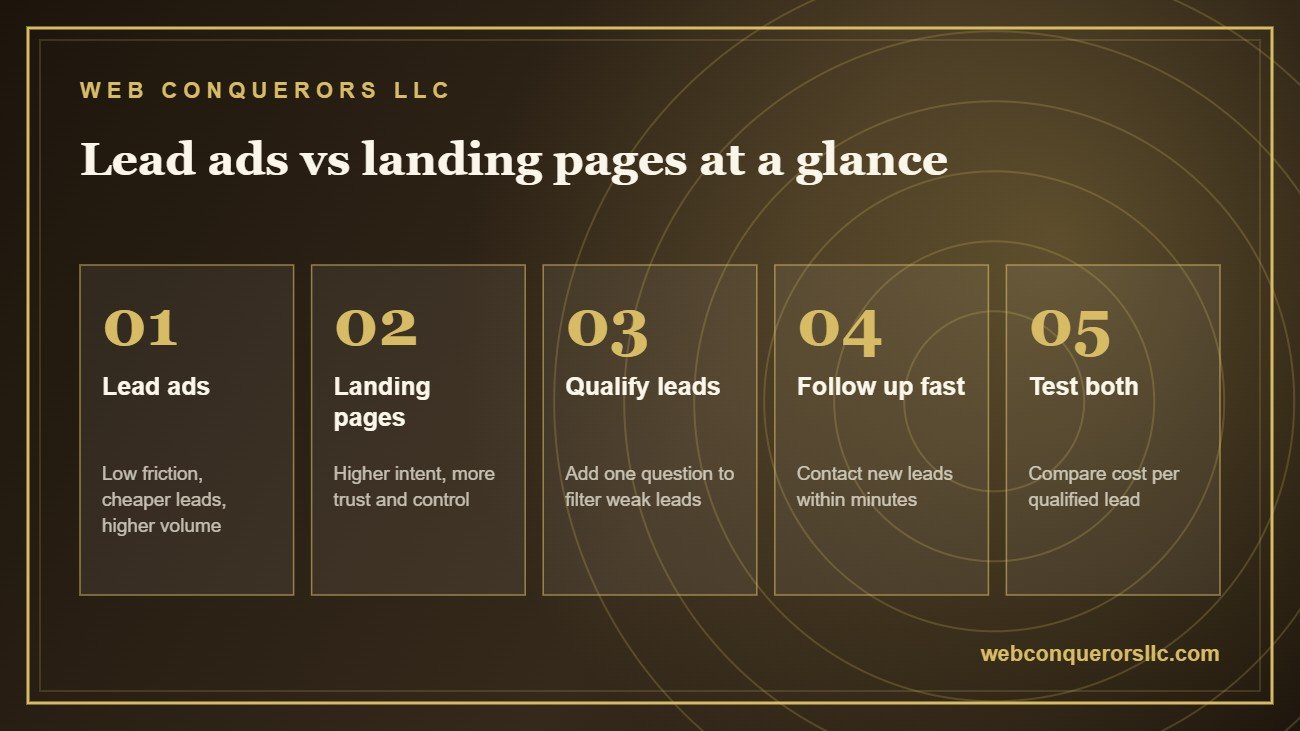
- Choose lead ads when you want volume, your offer is simple and you can contact leads within minutes, such as free quotes, giveaways or event sign-ups.
- Choose landing pages when the purchase is expensive or complex, when trust matters and when you want to filter out casual enquiries, such as legal, medical or high-ticket services.
- Test both when you are unsure, using the same budget and offer, then compare the cost per qualified lead, not just the cost per lead.
Lead Quality Tips for Either Format
- Add a qualifying question, such as budget or timeline, to filter weak leads
- Use higher-intent form options where available
- Be honest in the ad about what happens next
- Call or message new leads fast, ideally within five minutes
- Track which leads become customers and feed that back into targeting
These habits are central to our lead generation approach, which measures revenue and not only form fills.
Where Google Ads Fit In
Meta ads create demand by interrupting people who were not searching. Google ads catch people who are actively looking. Many businesses run both. If you are deciding where to begin, our comparison of Google Ads vs Meta Ads explains the differences, and our Google and Meta Ads service handles setup, testing and optimization for you. For tighter budgets, see our guide to internet marketing services under $500 for startups.
A Real Example
In our case study on generating high-value injury leads through Meta Ads, careful targeting and fast follow-up mattered more than the form type alone. The same lesson applies to your campaigns: the system around the ad decides the result.
Build a Landing Page That Converts
- One clear headline that matches the ad
- One main call to action
- Short forms and clear benefits
- Reviews, logos and proof near the form
- Fast loading on mobile
A strong website design and development setup makes landing pages quick to launch and easy to test.
Conclusion
Lead ads give you cheaper leads at higher volume, while landing pages give you better-qualified leads with more control. Match the format to your offer, qualify your leads and respond quickly. Whichever you choose, measure success by customers won.
Need help picking the right setup? Contact Web Conquerors LLC for a free review of your Meta ad campaigns.